Showing posts with label Google. Show all posts

Saturday, September 1, 2012

Google eBooks

Google eBooks (formerly Google Editions) is an e-book program run by Google , originally set to open in mid-summer 2010.] It was opened on December 6, 2010 to customers in the United States. It offers universal access and non-restrictive copying. The store is headed by Dan Clancy, who also directs Google Books.[  Google eBooks purchased at the Google eBookstore (Google eBooks' online store front) or other retailers are stored online and linked to the customer's Google account.] They can then be read online, or downloaded to a cache for offline reading. Holding purchased books on Google's server theoretically allows Google to serve books to users under a variety of formats, including new formats that might not be available at the time of purchase.

Reception

  Reception of eBooksStore at launch was mixed. Reviewers noted that it was still glitchy, and that books lacked reviews even for those that were centuries old. Also others remarked that Google touted the EBookStore as "open", but that it was still using Adobe's Adept eBooks Digital rights management.  Salon also remarked that searching for books was ironically not easy, and that integration with the older Google Books service was awkward. It also found that the interface was poorly done

Friday, August 31, 2012

Google Cloud Connect

Google Cloud Connect is a free cloud computing plug-in for Windows Microsoft Office 2003, 2007 and 2010 that can automatically store and synchronize any Microsoft Word document, PowerPoint presentation, or Excel spreadsheet to Google Docs in Google Docs or Microsoft Office formats. The Google Doc copy is automatically updated each time the Microsoft Office document is saved. Microsoft Office documents can be edited offline and synchronized later when online. Google Cloud Sync maintains previous Microsoft Office document versions and allows multiple users to collaborate, working on the same document at the same time.

Features

Google Cloud Connect can automatically or manually synchronize changes made to a Microsoft Office 2003, 2007, or 2010 document with Google Docs. Documents can be secured for private access by one user, shared with specific people for collaboration, or made public to anyone. Documents can be rolled back to previous revisions.
    Backup: Microsoft Office documents can be manually or automatically backed up to Google Docs each time they are saved locally.Video
    Synchronize: Changes made to an Office document on one computer can sync when the file is opened on another computer.[6] Video
    Protect: Microsoft Office documents synced to Google Docs can be made accessible to one person.
    Share: Microsoft Office documents synced to Google Docs can be made accessible only to selected people.
    Edit: A shared document can be set to only be viewed by others or edited as well.
    Publish: Documents synced to Google Docs can effectively be published by making them accessible to anyone.
    Collaborate: Multiple users can work on the same document at the same time.
    Notify: When one person edits a document, others sharing the document receive an email letting them know.
    Print: Use Google Cloud Print to print to local or remote network connected printers.
    Compare: Previous version are maintained allowing users to compare to older versions.
    Roll back: Users can go back to a previous version of the document.
    Green: Green computing allows documents to be shared without printing or sending large files. Only links need be sent.
    Mobilize: Google Sync allows synced documents to be viewed and edited with most internet connected mobile devices.
    Free: 1GB of storage is included for free. Currently additional storage costs per year are: 20GB-$5, 80GB-$20, etc. up to 16TB.

Google Data Liberation Front

Google's Data Liberation Front is an engineering team at Google whose "goal is to make it easier for users to move their data in and out of Google products." The team, which consults with other engineering teams within Google on how to "liberate" Google products, currently supports 27 products.] The purpose of the Data Liberation Front is to ensure that data can be migrated from Google once an individual or company stops using their services.

Google Takeout  On June 28, 2011, Google's Data Liberation Front engineering team released their first product, after 4 years in development, called Google Takeout, which allowed you to export data from supported services.  Google Takeout has been criticized for failing to include many Google services.


Google's audacious bet on fiber -- and why it could work

Google announced its Google Fiber initiative promising 1 gigabit of Internet speed for $70 a month and throwing in dozens of high-definition television channels for another $50 a month. The announcement was greeted with equal parts enthusiasm and skepticism.  The news elicited a lot of excitement and envy from geeks outside of Kansas City, where Google (GOOG) had chosen to do a pilot run of the project. Not only would Google waive the $300 installation fee for early subscribers, it would give them online access that's 500 times faster than the 2-megabits-per-second access most Americans have lived with for much of the past decade.  But that wasn't all. Google Fiber also offered the ability to record eight TV programs at a time. And to download a single high-def movie in seven seconds (versus 22 minutes for a 5mbps connection). And a free Nexus 7 tablet as a remote control. And a free terabyte of data storage on Google Drive. And, on top of all this, no data caps.  MORE: The information economy is reaching maximum overload  A week after the announcement, Google had signed up more than 7,000 homes in Kansas City, 4,900 in Missouri and 2,100 in Kansas. That's about 5% of the cities' total homes. Residents are halfway through the six-week rally to get others in their designated "fiberhoods" to sign up. As of this week, some neighborhoods have as much as 39% of their homes plugged in.  It's a promising start, but the debate is far from settled over whether Google Fiber will be disruptive in the way its search engine or Gmail was, or whether it will be an interesting -- but costly -- experiment like the company's plan to sell the Nexus one through its own online store.  That debate is likely to continue for several years, because it's going to take that long for Google Fiber to have anything more than an incremental impact on the way people access a high-bandwidth Internet. What's clear is that Google Fiber, as conceived at launch, has a lot going for it. But it also has a lot going against it -- notably the entrenched power of the giant ISPs Google is taking on.  MORE: Netflix has an identity problem  Verizon (VZ), for example, has offered its FiOS fiber-optic plan in select cities for years. The company says it has 4.2 million subscribers receiving 530 channels and broadband speeds up to 150 mpbs for the price of $205 a month. Verizon also claims to have spent $23 billion on the network, although some observers have questioned its numbers.  AT&T (T), Time-Warner (TWX) and Comcast (CMCSA) also offer Internet/TV plans at lower speeds. Unlike Google, they have longstanding relationships with their ISP customers and a stronger brand recognition in the broadband game. If Google expands its Fiber program to other cities, it will need to spend more on customer support -- which can be a quarter of an ISP's costs -- and compete for a broad array of cable channels.  In its favor, however, Google has launched Fiber with a thought-out plan aimed at the biggest frustration surrounding current ISP plans: relatively slow speeds at high prices. As video chat, streaming media and photo sharing have increased, people are finding their broadband isn't broad enough anymore. The U.S. is 15th on Akamai's list of the countries with fast broadband. Google Fiber offers faster speeds at lower prices than most ISP's offer today.  MORE: The trend that terrifies Big Tech  Google is also using the power of old-fashioned social networking to draw subscribers. The fiberhoods in Kansas City have incentives to get neighbors to sign up -- higher subscription rates bump you to the front of the line, and ensure that schools and emergency responders have access to fiber connections.  There is also a risky cost-versus-return bet that Google is taking. The Kansas City project will cost $500 million. Scaling that up to many cities would quickly burn through Google's $43 billion in cash. But the surge in broadband content could bring Google new revenue from web and TV advertising. And by becoming an ISP, Google could win a strong presence in many U.S. living rooms.  Google Fiber is one of the most ambitious undertakings in the company's history, up there with the push to redesign all Google sites around the social structure of Google+ and the surprising move to pay $12.5 billion for Motorola.  MORE: Hulu's network drama  Right now, Google's chances at disrupting the major ISPs looks like a long shot. But this is a gambit that will take years to play out, and it's way too early to count Google out if it's serious about offering one-gigabit access to millions of people at a rate competitive with much slower connections today. It's dramatically improved the business case for high-bandwidth access, in a way that incumbents will have to work hard to avoid.  As Ben Schacter, an analyst at Macquarie Securities, said in a recent report, "this initiative is less about a long-term revenue opportunity for Google and more about pushing current Internet providers to increase speeds and innovate (which could benefit Google in the long run)."  And that may be the real goal for Google. Not to take business from ISPs, but to get them to get their act together – improving service for consumers, and increasing revenue for many companies.

Wednesday, August 29, 2012

Micromax A56 price, Micromax A56 Features Google Android v.2.3 Gingerbread

Micromax has released a brand new and highly-sophisticated mobile phone that delivers to the buyers and new line of features. Micromax A56 price in India is a very affordable one and at Rs.5999 the handset is aimed at making your life easier and a lot simpler.

Micromax A56 price is inexpensive when considering the astonishing features and specifications it combines and delivers. At Rs. 5999 you can get your hands on a handset that is powered by a Qualcomm single-core processor that runs at 800 MHz. The processor will grace you with the chance to run multiple tasks on your handset and to easily work on it fast and without any stalling.

Micromax A56 features the Google Android v.2.3 Gingerbread edition. This is one of the latest versions of the operating system and the user is given the opportunity of having direct access to a vast range of applications, both entertaining and business alike. There is no restriction on getting your hands on these applications and you can make your phone even more powerful and useful too.

Micromax A56 specifications are many and there is truly a long list of amazing features that render this handset a useful and entertaining option as well. The mobile phone operates on both a 2G and a 3G network and it provides the best of both networks. This way, downloading from the internet can be completed in less time and the phone call and text charges can be less.

Micromax A56 price in India is very logical and as it is estimated at around Rs. 5999 it makes the handset a valuable and helpful gadget. The phone comes embedded with a gyroscope, an accelerometer and a light sensor too and it aims at making your life easier.

Google Questions and Answers

Google Questions and Answers is a free knowledge market offered by Google that allows users to collaboratively find answers to their questions (also referred as Google Knowledge Search). It was launched in June 28, 2007 and replaces the fee-based Google Answers service, discontinued on December 1, 2006. Google had chosen Russia as the first country to launch this new service.

Technologically, Google service most closely resembles analogous services by mail.ru, Naver and Yahoo!. It is pseudonymous: the nicknames of the authors of questions and answers are shown right next to their contributed content. Google uses question tagging to help users find relevant questions.

As most services of this kind, Google provides an incentive system to motivate people to answer questions. It is based on assigning points for actions and a system of levels loosely based on the Russian system of academic degrees. An interesting feature of the incentive system is that Google's reward for visiting is higher than for posting an answer.

On August 20, 2007, Google and Tianya Club, a Chinese community website, launched a free Q&A service entitled "Tianya Answers".

More languages were added, including English. The site is known as Google Baraza
Contents

 Predecessor

Google Answers predecessor was also called Google Questions and Answers, which was launched in August 2001. The previous service had Google staffers e-mailing responses to questions for free. It was up and functional for about a day. The demand may have overwhelmed their resources 

Future

Google bought a similar site for $50 million in 2010, but discontinued it in 2011. Google has earlier done the same thing with others services that they later have integrated within their own software. The site was called Aardvark


Google Certification Program

It replaced Google Advertising Professionals in April 2010, including changes such as amended criteria for entry and changes to the training structure and exam requirementsThe program continues to certify consultants to help the increasing number of new Google AdWords clients with their AdWords campaigns.may have done thel local time.and complete idea about of the google Certification Program. There is one fundamental exam and three advanced exam in this program. The advanced exams are the Search Advertising Advance Exam, Display Advertising Advance Exam, and Reporting & Analysis Advance Exam. In order to be individually qualified a person must pass the fundamental exam and one advance exam. The type of advance exam taken will determine the type of adwords qualification one will receive. To be a Google certified partner an agency must have one Google qualified employee, have spend 60 out of 90 days, managed a $10,000 spend in the last 90 days,and have been active in the last 90 days.

Tuesday, August 28, 2012

Apple sue us next? Not a chance.

Apple sue us next? Not a chance.
That's the gist of Google's message following Apple's $1 billion victory over Samsung in a California patent suit. The search giant is doing its best to quell fears that its Android operating system could be the next target for Apple's lawyers. And you can't blame them.
Google has to do something to keep its partners in the smartphone and tablet world from panicking, to say nothing of investors. But experts say that while the Apple v. Samsung suit didn't describe a legal route that leads directly to Mountain View, Google had better watch its back.
Apple v. Samsung ripped apart both the hardware and software used in Samsung's very popular smartphones and tablets. Arguments hinged on whether certain hardware features -- like a bezeled display and a lozenge-shaped earpiece -- had been ripped off from Apple by Samsung's designers. A jury decided that in multiple instances they had.

Apple also filed claims that Samsung developed operating system features that violated Apple patents. Samsung licenses Google's Android operating system for its tablets and phones, and makes changes to personalize the user experience. Those small changes include pinch-to-zoom, tap-to-zoom, and bounce-back features, which fall under Apple-owned utility patents.
Google, which has stayed silent about the case until now, said Monday that these utility patent features aren't part of the core Android operating system, which runs underneath Samsung's and other device manufacturer's modifications. Google gives its licensees a plain, stock version of the Android operating system, which by itself does not violate Apple's patents. However, licensees can modify the Android system and build any feature they like, and those features could violate other patented technologies.
Here's Google's full statement in reaction to the verdict:
"The court of appeals will review both infringement and the validity of the patent claims. Most of these don't relate to the core Android operating system, and several are being re-examined by the US Patent Office. The mobile industry is moving fast and all players -- including newcomers -- are building upon ideas that have been around for decades. We work with our partners to give consumers innovative and affordable products, and we don't want anything to limit that."
Phillip Philbin, an intellectual property attorney with national law firm Haynes and Boone, says Google's statement is a message to its partners that the verdict only applies to Samsung's products, and not the entire Android ecosystem. "It's essentially Google saying that the patent issues apply to Samsung's software changes and Samsung's hardware, but not to 'core' Android or other Android products," says Philbin.
Looking at the case, Purdue law professor Mark McKenna says Google is focusing on distancing itself from the pinch-to-zoom, the tap-to-zoom, and the bounce-back features that Samsung created, saying they aren't included in its base Android code. "Google's claim is that those features are part of the modified experience from other companies that license the Android operating system," says McKenna.
Analysts agree with Google's stance, saying there is no evidence out there that the core Android operating system has infringed on Apple or any other company's patents. But Google has yet to endure the scrutiny of a full-blown patent suit. The California jury was looking at what Samsung did or didn't do, not what Google did or didn't do. That's a key distinction. But if Google has its way, no jury will ever test its claims.
Google has gone to great lengths to keep its operating system distinct from iOS with widgets, rotary and pull-tab lock screens, and an applications menu separate from the home screen. All very un-Apple-like design flourishes. Even Google's Nexus hardware line, made with Samsung, HTC, and Asus, includes designs with rounded corners, curved screens, and textured battery covers that could never be mistaken for an Apple device.
Still Google is not immune to a patent lawsuit, even though it wouldn't be easy for Apple -- or anyone else -- to bring a case. One of the chief reasons Apple hasn't yet gone after Google, McKenna says, is because Google doesn't make any money from selling the Android operating system (it makes money from mobile ads). Since Google is giving away Android, it makes it hard for Apple to prove that the operating system harms its market share.
"That doesn't mean Apple couldn't sue Google, it just makes it more challenging to prove the direct impact," says McKenna. "That's why Apple's gone the indirect route, by suing device manufacturers that can modify Android."
And it's not inconceivable that Apple eventually decides to go directly after Google, McKenna says. If it gets on a winning streak in U.S. courts against the rest of the handset makers, it might take a shot. "This is Act 1 in a multi-act play," says McKenna. "Apple is on the record saying they want to destroy the Android ecosystem, and to do that it's either going have to go after the all the software makers, or every single hardware manufacturer that sells these things."
Whether its Apple going after its next victim, or the Samsung case going to appeal, Philbin agrees there is a long way to go. "Patent litigation takes place on at least three fronts — the district court, the patent office and the federal circuit," he says. "What we've had so far is just the district court's ruling and we haven't even heard from the District Judge on this yet. So this process is far from over."
The legal process perhaps, but as is the case in the fast-moving tech world, the design process has already moved on. Pick up the latest Samsung smartphone and you won't see the hardware or software features that the jury found violated Apple's patents. Samsung has learned its lesson, albeit in a very expensive way. Google already has a tight grip on Android, and you're likely to see that grip tighten as it looks to avoid any of its own patent litigation woes.
The good news for consumers is that rather than waiting for jury verdicts in the future, there's a good chance we'll be waiting for the next crop of smartphones and tablets with forms and features that are distinct -- not just a bunch of Apple copycats.

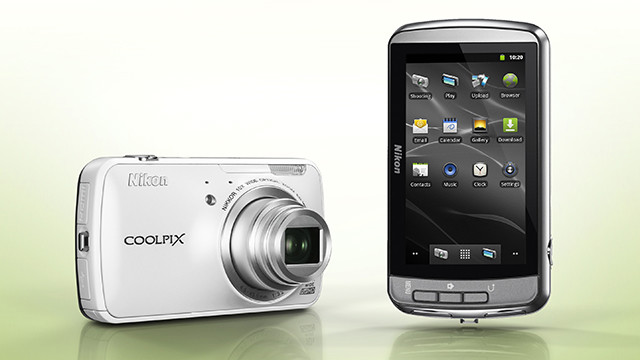
Nikon's latest camera runs Android

Nikon's newest point-and-shoot camera, the Coolpix S800c, is powered by the Android 2.3 operating system.
- The gulf between smartphones and cameras is getting smaller, thanks to a new point-and-shoot camera from Nikon that's powered by the Android operating system.
The 16-megapixel Coolpix S800c camera, announced Wednesday, will be the first camera running Android on the market when it hits shelves in September.
The addition of Android brings a few much-needed features to the point-and-shoot. Users can download mobile apps from the Google Play store and share images over cellular networks by tethering to a nearby smartphone or tablet.
Pinterest releases new iPad and Android apps
When phone makers first started adding tiny, low-resolution cameras to their devices, the camera industry was not terribly threatened. They had glorious digital SLR cameras with interchangeable lenses, sleek pocket cameras with large sensors and manual controls, and features like high-ISO for low-light shooting, megazoom, and rugged bodies for the outdoors.
Anyone who loved photos would certainly prefer the high-quality shots captured on "real" cameras, right?
But the camera companies underestimated just how important convenience was to consumers, and the public's appetite for sharing photos of moments right when they happened. The resulting cellphone images were low-quality, but nothing a little sepia-filter couldn't fix.
The iPhone was not the first phone to have a camera, but it made sharing images online, over its cellular connection, a snap. In 2011, more than a quarter of photos and videos were captured using a smartphone, according to a study from research company NPD Group. That number is only getting larger.
The $350 Coolpix S800c is bringing some of what has made those smartphones so popular to a camera. It doesn't have a cellular connection, but it does have Wi-Fi. Wireless connections have been around for a while on cameras, but the addition of Android means the camera can tether to a smartphone or tablet running Android when there's no Wi-Fi network handy.
The 3.5-inch touchscreen display gives users access to the Google Play store, where photogs can go to download more apps for their camera, including editing tools and social networks, such as Twitter, Facebook and, of course, Instagram. The camera can also run all the regular smartphone apps, allowing users to send e-mail, browse the Internet, listen to music and play games.
Like Apple's iPod Touch, it draws the line at making phone calls, however.
The camera has 10X zoom, can shoot 1080p video, and includes GPS and maps for tagging images with locations. There are no manual controls. The S800c is running Android 2.3, known as Gingerbread, which is not the most recent version of the operating system.
That Nikon is the first to bring an Android camera to market is a surprise, since competitors Sony and Samsung already make Android devices and were in a better position to combine the two products. Polaroid showed off a demo camera running Android at the Consumer Electronics show in January, the SC1630, but it isn't yet available.
Nikon's Android camera may be a first in the camera industry, but it's still playing catch-up to the real competitors: smartphones with increasingly higher-quality cameras.